Free
For individuals and side projects.
$0 / month
- 1 user, unlimited notebooks
- Experiment tracking and comparison
- Shared CPU compute
- 1 deployed model
maclnote is where your team trains models on real GPUs, keeps the hyperparameters, learning curves and validation metrics of every run, versions the data each model was trained on, and puts the best model behind a prediction API that watches its own accuracy.
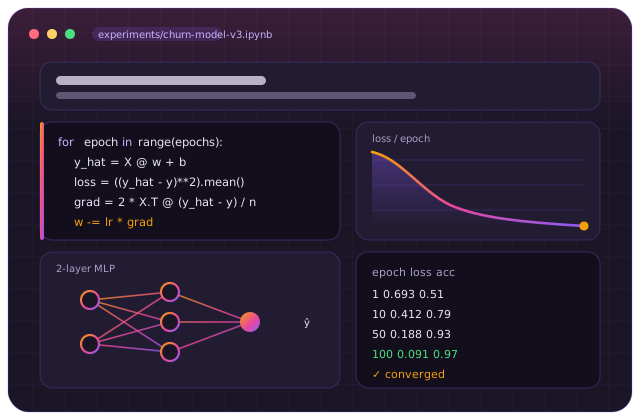
Knowing which of your two hundred runs was actually best on held-out data, which rows it was trained on, whether it is overfitting, and how accurate it still is six months after deployment is the hard part. maclnote records all of that for every model, automatically, as you work.
Jupyter-compatible notebooks with a GPU attached in seconds. Fit a gradient-boosted model on ten million rows or fine-tune a transformer, then release the GPU when training finishes.
Hyperparameters, learning curves, validation metrics per fold, confusion matrices and the random seed are captured from every fit. Compare two hundred runs in a table instead of from memory.
Each run knows the exact rows and features it trained on, and the split it was validated on. Retrain a model a year later on the same data, or trace a bad prediction back to the examples behind it.
Compare candidate models on held-out metrics and per-segment accuracy, approve the winner with its evaluation report attached, and deploy it as a prediction API or nightly scoring job in one click.
Live feature and prediction distributions are compared with the training data every night. When true labels arrive, accuracy, precision, recall and AUC are computed and plotted against the drift history.
Ask why validation loss started climbing at epoch 12, which features separate your two best runs, or what changed between the deployed model and the one before it. Answers cite your runs.
No migration project. Connect the table you already train on, open your notebook, and the first training run is recorded before the coffee is cold.
Point maclnote at the warehouse table, bucket or file you train from. Each time a notebook reads it, the exact rows are fingerprinted and versioned, so every model knows what it learned from.
Fit models the way you already do, in PyTorch, scikit-learn, XGBoost or anything else in Python. Hyperparameters, learning curves and validation metrics are recorded for every run, and sweeps run in parallel on GPUs.
Compare runs on held-out metrics, calibration and accuracy per customer segment. Approve the best model with its evaluation report, training data version and code attached, so a reviewer sees everything on one page.
One click gives you a versioned prediction API or a scheduled scoring job. Feature drift is checked nightly, accuracy is computed as labels arrive, and rolling back to the previous model takes seconds.
Train with any Python machine learning library, read training data from the warehouses and buckets where it already lives, and deploy where your engineers already run services. See all integrations.
Whether you are three people with one churn model or fifty data scientists with hundreds, the problems are the same: reproducing a result, agreeing which model is best, and knowing how accurate the deployed one still is.
Stop losing the run that hit 0.91. Every training run is reproducible, comparable on held-out metrics and shareable by link.
Give twenty data scientists GPUs, experiment history and prediction APIs without building and maintaining the tools yourself.
Sweep thousands of hyperparameter configurations, keep every checkpoint, and hand a reviewer the exact notebook and data behind a figure.
Put a model behind a prediction API this week, with accuracy monitoring, on a two-person team.
Training data lineage, model approval workflows and audit logs for every model, in your own cloud.
Give every student a GPU notebook and grade training runs you can re-execute, not zip files.
Unlimited training runs and models on every plan. You pay for the people who train models and the GPU minutes they use, not for how much they experiment.
For individuals and side projects.
For teams shipping models together.
For large ML teams and regulated industries.
We will open your notebook in maclnote, train it with the run recorded, compare two configurations side by side, and deploy the better one as a prediction API. Live.